5 Sharing Teaching Practice
If you focus primarily on teaching, LinkedIn offers a way to share your work with people who might benefit from it. Teaching innovations developed in isolation get reinvented constantly across institutions. Sharing what you do breaks that cycle.
5.1 What to Share
5.1.1 Teaching approaches and innovations
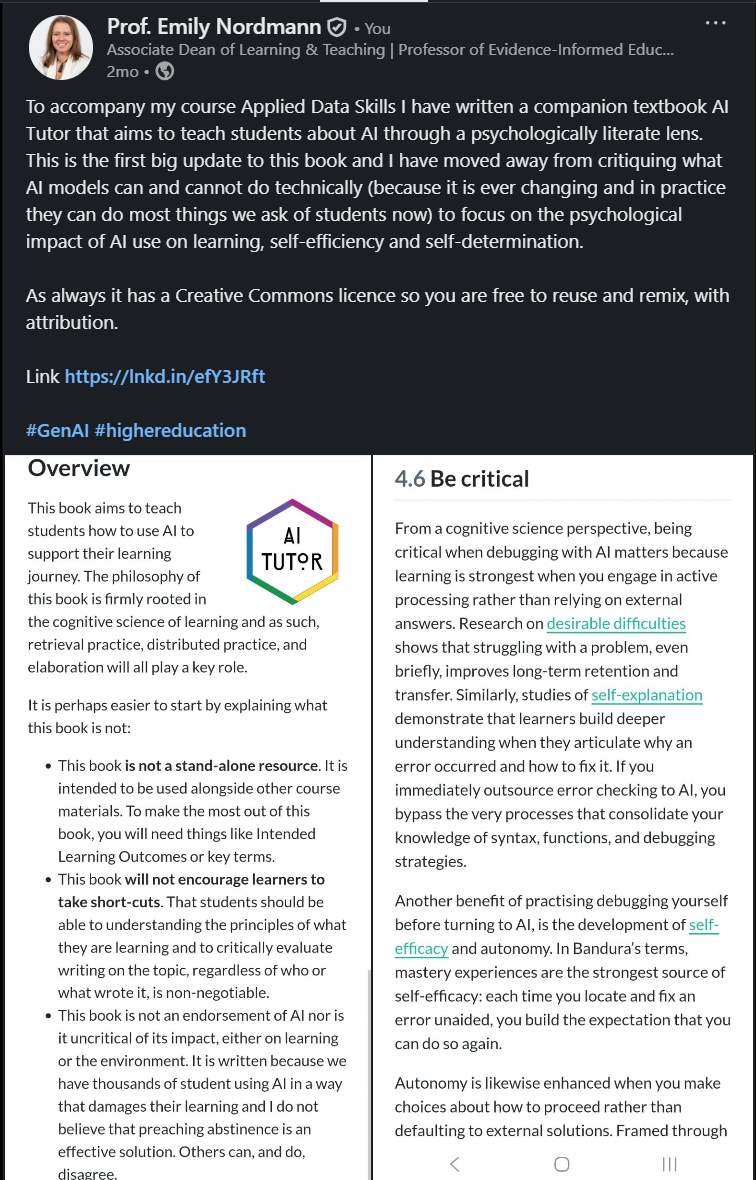
Share what you do in your teaching and why. A new approach you tried and how it went. An assessment design that worked well (or did not, and what you learned). How you structure a particular type of session.
Be specific enough that others could adapt your approach.
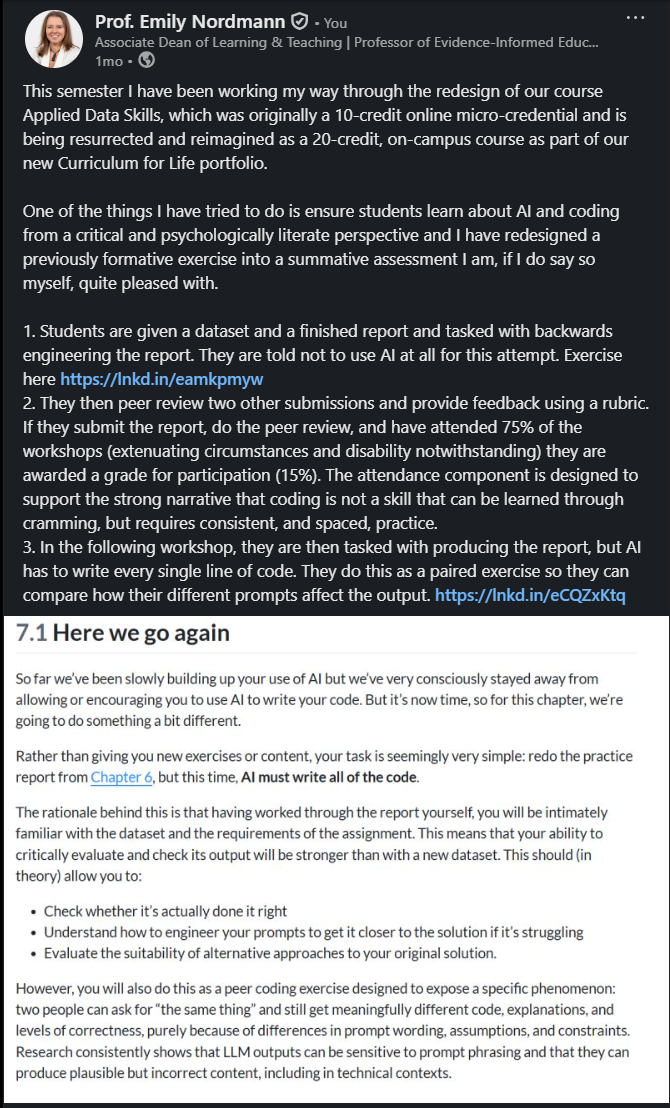
This shares enough detail that someone could implement a similar approach and explains the pedagogical reasoning.
5.1.2 Commenting on current issues
When issues come up in higher education that relate to your expertise, say something about them.
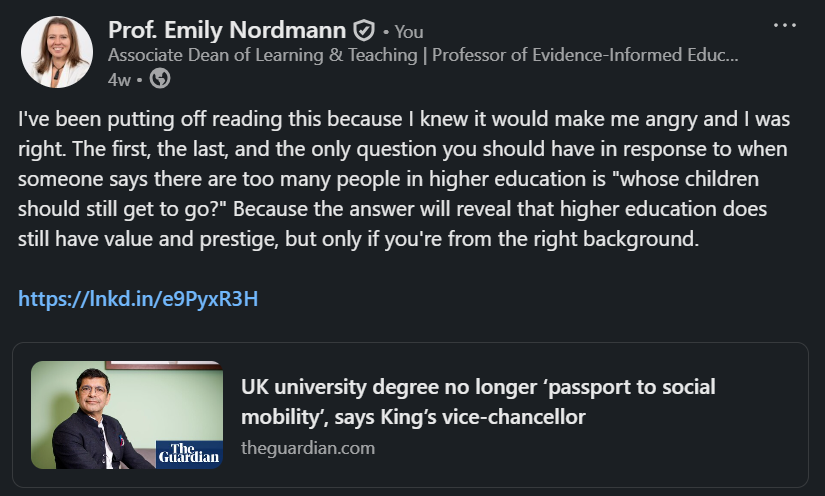
This shows that you engage critically with current debates rather than just observing them.
5.2 Sharing Open Educational Resources
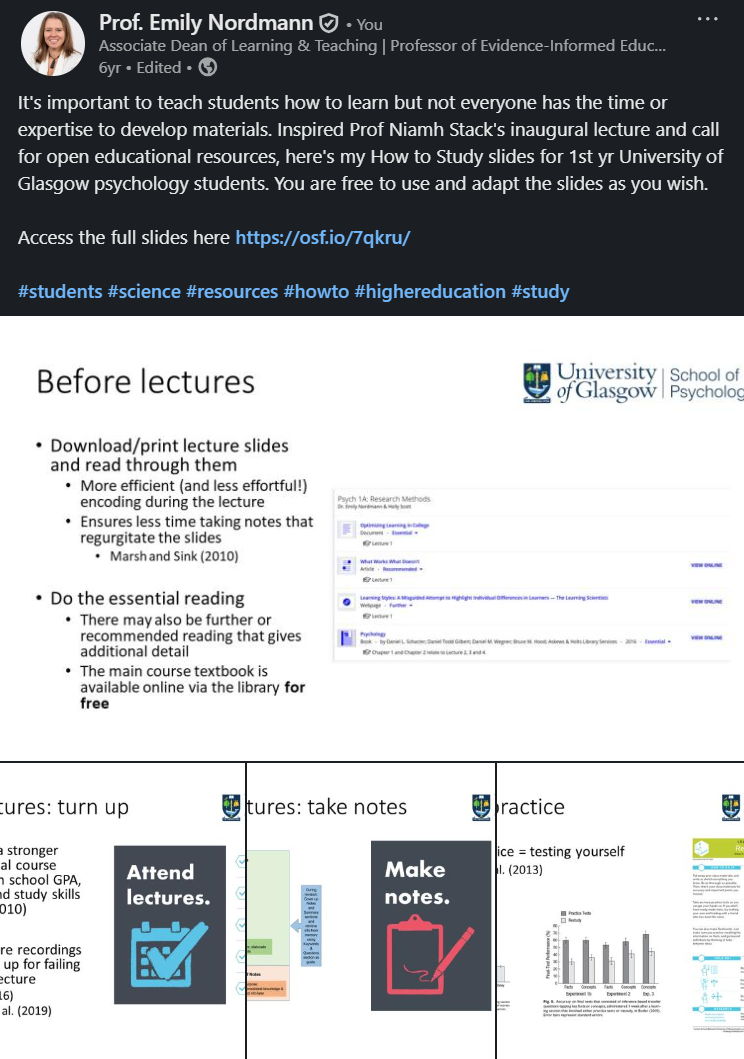
If you create teaching materials, making them openly available means they can be used beyond your own institution. Many educators create similar resources in isolation, and across institutions people spend enormous amounts of time developing introductory lectures, assessment rubrics, and practical guides that already exist elsewhere. Open educational resources can break this cycle.
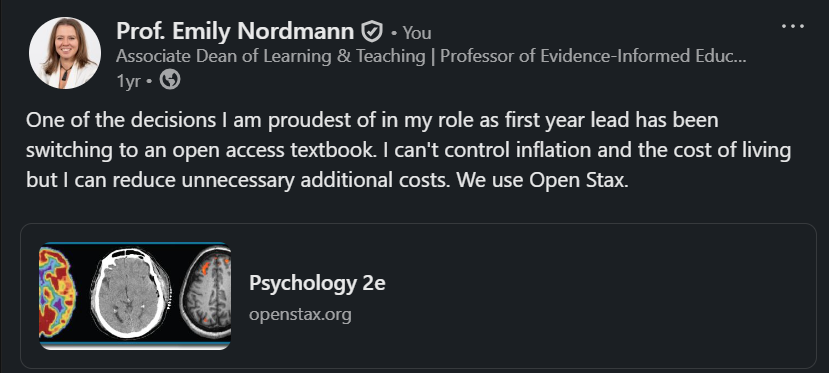
There are also personal benefits. Your expertise becomes visible beyond your institution and you may receive feedback that improves your resources. You also create documented evidence of impact, which matters if you are on a teaching-focused track where demonstrating reach is part of your promotion case.
5.2.1 Why LinkedIn for OER?
OER repositories are important for hosting and findability, but they are passive. People have to find your resources through search or browsing. LinkedIn lets you actively push resources to people who might use them.
When you share an OER on LinkedIn, you can explain the context that repository metadata cannot capture. Why you created it, how you use it, what you would do differently. You can invite feedback and you can reach people who would never have searched for your resource but might find it useful.
5.2.2 Licensing your resources
For a resource to be genuinely open, it needs a licence that explicitly permits reuse. Without a licence, copyright applies by default, meaning others cannot legally reuse your work even if you share it publicly.
The most common approach is Creative Commons. For maximum impact, use CC BY (Attribution). Others can use, adapt, and redistribute your work, including commercially, as long as they credit you. This matters because if you want recognition for your work, CC BY requires attribution. Anyone using your resource has to credit you. This is important for tracking impact and making sure you get credit.
Other options like CC BY-NC (non-commercial) or CC BY-SA (share-alike) are available but limit reuse in ways that may reduce impact.
Include licence information in the resource itself (on the first or last slide, in the document footer), in the LinkedIn post sharing it, and in any repository listing.
5.2.3 Hosting your resources
Where you host your resources matters for whether people can find them and whether they will still be there in five years.
Institutional repositories (Glasgow’s is Enlighten) provide stable hosting, institutional recognition, and usually generate DOIs. Check what your institution offers.
Open Science Framework is free, easy to use, and provides DOIs, version control, and download analytics. Good for individual resources or collections.
Zenodo is another free option, run by CERN. It generates DOIs automatically and integrates with GitHub.
GitHub is good for code and version-controlled documents. Integrates with Zenodo for DOI generation.
Personal websites can work but have limitations. They do not generate DOIs (which matters for citation and tracking), and may not provide usage analytics.
DOIs matter because they make your resources citable. If someone uses your resource in a publication or training materials, a DOI makes proper citation straightforward and lets you track where your work is being used.
5.2.4 How to share OER on LinkedIn
When sharing an OER, include what it is (and be specific: “lecture slides” is too vague, “a set of 12 lecture slide decks covering introductory research methods in psychology” is specific enough to evaluate), who it is for, how to access it, the licence, and any context or guidance on how you use it.